Your ferritin won't budge. There's an order to troubleshooting it.
A step-by-step roadmap for women whose labs came back "normal," whose iron supplements did nothing (or wrecked their stomach), and who are done guessing.
Written by a functional dietitian whose own ferritin went from 9 to 77 in four months.
You've done the thing where you are googling your own lab results at 11pm.
You know your ferritin number like you have memorized your phone number.
You know roughly what it was two years ago and what it was at your last draw, and you’ve done the mental math on whether it’s moving. You’ve probably had an appointment where someone glanced at the screen and said everything “looked normal”, and you sat there thinking then why can I not get through a Wednesday.
So you took iron.
Maybe the gentle kind, because the first kind made you nauseous, then you tried iron with vitamin C, because everyone says with vitamin C.
But you took it for three months, or six, or longer than you want to admit. And when you retested, the number had moved four points. Or it hadn’t moved at all.
The hair in the shower drain is a separate small grief you don’t really talk about.
And somewhere in there, a quiet thought started forming: maybe this is just how my body is now.
But you so desperately want to feel human again!
Don't worry, I got you!
I made this troubleshooting guide exactly for you if…
Your ferritin is low, borderline, or “fine according to the lab” and you feel anything but fine
You’ve been taking iron and the number isn’t moving the way anyone said it would
Iron supplements make you constipated, nauseous, or both, and you’ve quietly stopped taking them
You’re exhausted, cold, losing hair, or getting winded on stairs that never used to be a problem
You’ve been handed a prescription for iron with no explanation of why yours got low in the first place
You have heavy periods and have been told that’s normal
You’re considering an infusion and want to understand your situation before you make that call
You have a folder of lab results and no idea which numbers matter
Here's where most women get stuck
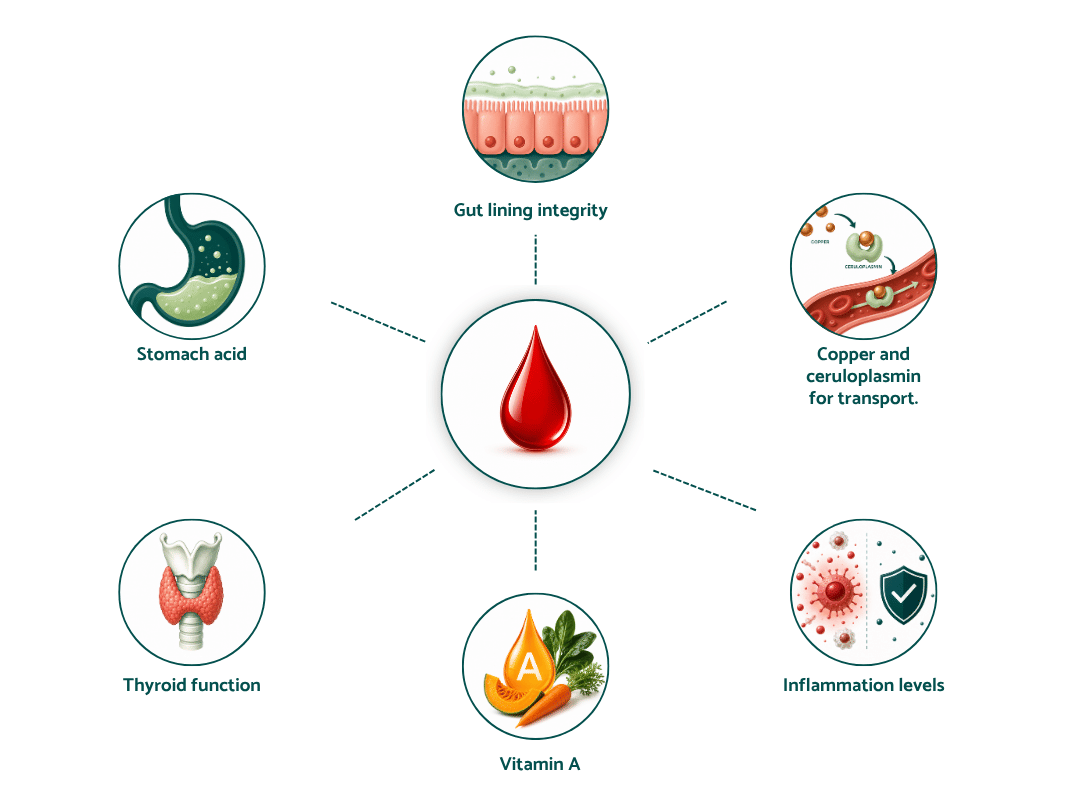
Iron is one handoff in a relay race.
Getting iron into your body is the first leg.
After that it has to survive your stomach, get absorbed across your gut lining, get picked up and carried through your blood, and finally get stored in the warehouse (that’s ferritin, your storage form).
What you haven’t been told:
Every one of those handoffs depends on something other than iron.
Inflammation raises a hormone called hepcidin that essentially locks the warehouse doors and blocks absorption at the same time.
So a woman can take iron every single day for six months and watch her ferritin sit at 27, and it isn’t because she is taking the wrong form. It’s because iron was being handed to a runner who wasn’t ready to run
Which brings up the part nobody mentions:
when the pathways are inflamed and you keep adding iron anyway, you can make things feel worse.
Free, unbound iron is inflammatory. Adding it to a system that’s already inflamed can be like pouring gasoline on a forest fire.
And there's the other question, the one that gets skipped entirely
Why did your ferritin get low in the first place?
Was it heavy periods? Three pregnancies in five years? Low stomach acid so you’re not liberating iron from food? Something going on in the gut?
If you fill a bucket without finding the hole, you’ll be back here in a year.
That’s usually the missing piece. Not the supplement. The order.
What changes when you have the order
- You stop buying supplements based on a what you see on TikTok.
- You walk into your next appointment with a specific list of what you want run, and specific reasons why, and the conversation goes differently because you're participating in it.
- You get your results back and you actually know what you're looking at. The flagged values, the ones that weren't flagged but should have been, the ratios that only mean something in context.
- You know whether iron is your next step, and if it isn't, you know what is. And if it is, you know what needs to happen first so it actually lands somewhere.
- And a few months from now there's a morning where you get up before the alarm, and you're partway through making coffee before you notice you didn't have to talk yourself into being upright.
What you get
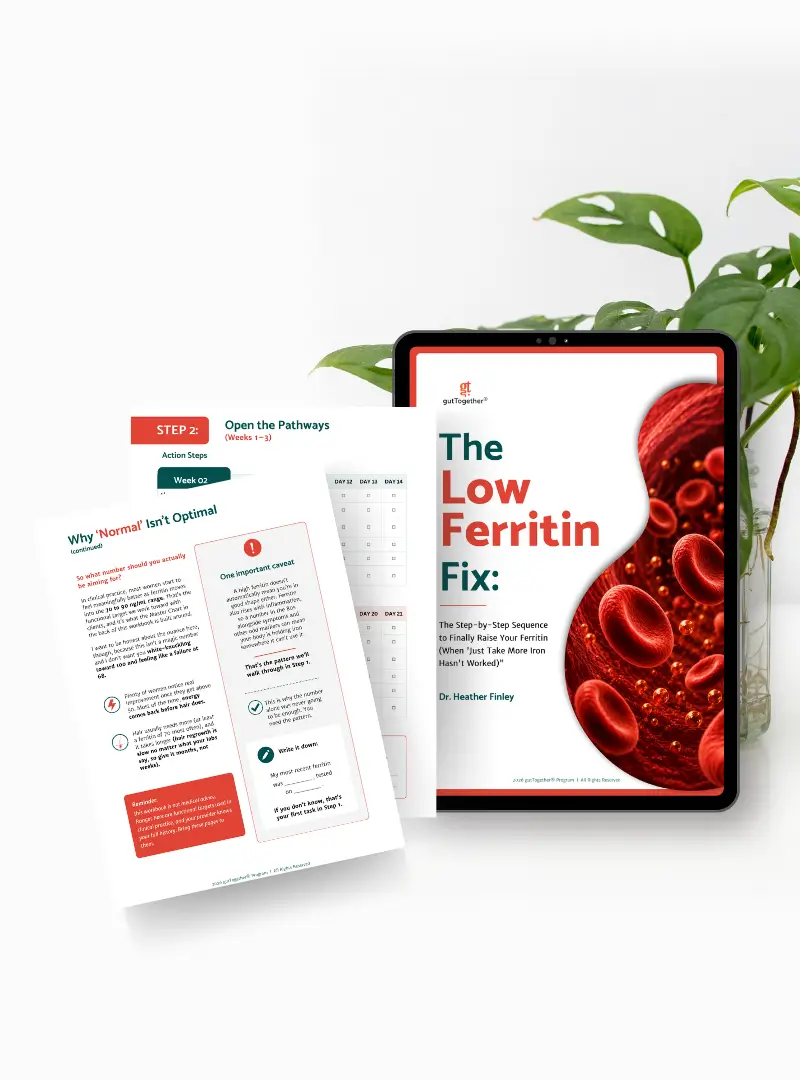
The Low Ferritin Troubleshooting Guide is a five-step workbook you move through in order.
This is a step by step guide on exactly what you need to do to increase your ferritin.
Get the Right Labs
The complete list of what to ask for and why each one matters. Ferritin alone is not a complete picture, and this is where most troubleshooting fails before it starts. Includes exactly what to say to your provider when you request them.
Open the Pathways
Digestion, stomach acid, and absorption. Iron can’t enter a system that isn’t ready to receive it, and this is where you find out whether yours is.
Restore Transport
The nutrients and mechanisms that carry iron and get it into storage. This is the step that explains why six months of supplementation can produce almost nothing.
Add Iron Only If Needed
Clear criteria for whether iron is your next move, what form, when, and what to pair it with. Plus the situations where more iron isn’t the answer at all.
Retest and Track
When to retest, what to look for, and how to read whether it’s working. So you’re never guessing again.
The Low Ferritin Troubleshooting Worksheet
Plus the troubleshooting worksheets to fill in as you go, so by the end you’re holding your own picture rather than a general one.
Instant digital access. Yours forever.
Real Results
Casey Increased Her Ferritin from <20 to 80

Jessica Increased Her Ferritin 20 points in 2 MONTHS!

Why I built this
My ferritin was 9.
I was exhausted in a way that made me a worse mom and a worse clinician, I was cold all the time, and my hair was coming out by the handful. I had a doctorate in clinical nutrition and I could not fix my own labs, which is a specific kind of humbling.
I’d been doing what everyone does. Taking iron. Adding vitamin C. Switching the form…and just waiting.
Everything changed when I stopped treating it as an iron problem and started working through it in order (finding out why it got low, opening the pathways, restoring transport, and only then dealing with iron itself). Four months later my ferritin was at 77.
I’ve since walked hundreds of women through the same sequence, and I’ve watched women who came in under 20 get to 75 and above using this way of thinking. Not because of one supplement. Because of the order.


I want to be straight with you about what this is. This workbook is the map. It’s how my team and I think through a case, written down so you can work it yourself. It is not a personalized protocol and it doesn’t replace your provider. What it does is put you in a position to have a much better conversation with them, and to stop wasting months on steps that were never going to work in the order you were doing them.
The things you're probably thinking
“I’ve already tried everything”
I believe you. Most women who buy this have. But there’s a difference between trying many things and trying them in a sequence, and almost nobody has done the second one. Many failed protocols are sequencing failures.
If you’ve taken iron, changed your diet, and added vitamin C without first checking whether your pathways were open or you can actually absorb iron, you haven’t actually tried this yet.
“Is this just going to tell me to take iron?”
No. Iron is step four, and there’s a whole page devoted to when the answer is not yet. Half of what’s in here is about the conditions that have to exist before iron does anything useful.
“Will this replace my doctor?”
It won’t, and it isn’t trying to. Nothing in here diagnoses anything or tells you to stop something you’ve been prescribed. It’s designed to make you a better-informed participant in your own care. Bring it to your appointment. That’s what it’s for.
“$27 for a PDF?”
I get the hesitation. Here’s the honest math: one round of the wrong supplement runs you more than this, and costs you three months. This is the cheapest way to find out whether the thing you’re about to do is the right next thing.
“What if I don’t have a recent labs”
Then you’re starting exactly at step one, which is where the workbook starts. That’s the ideal place to be.
HOW MUCH?
Feeling like yourself again is
worth the investment.
(We’ve been told we should really charge more!)
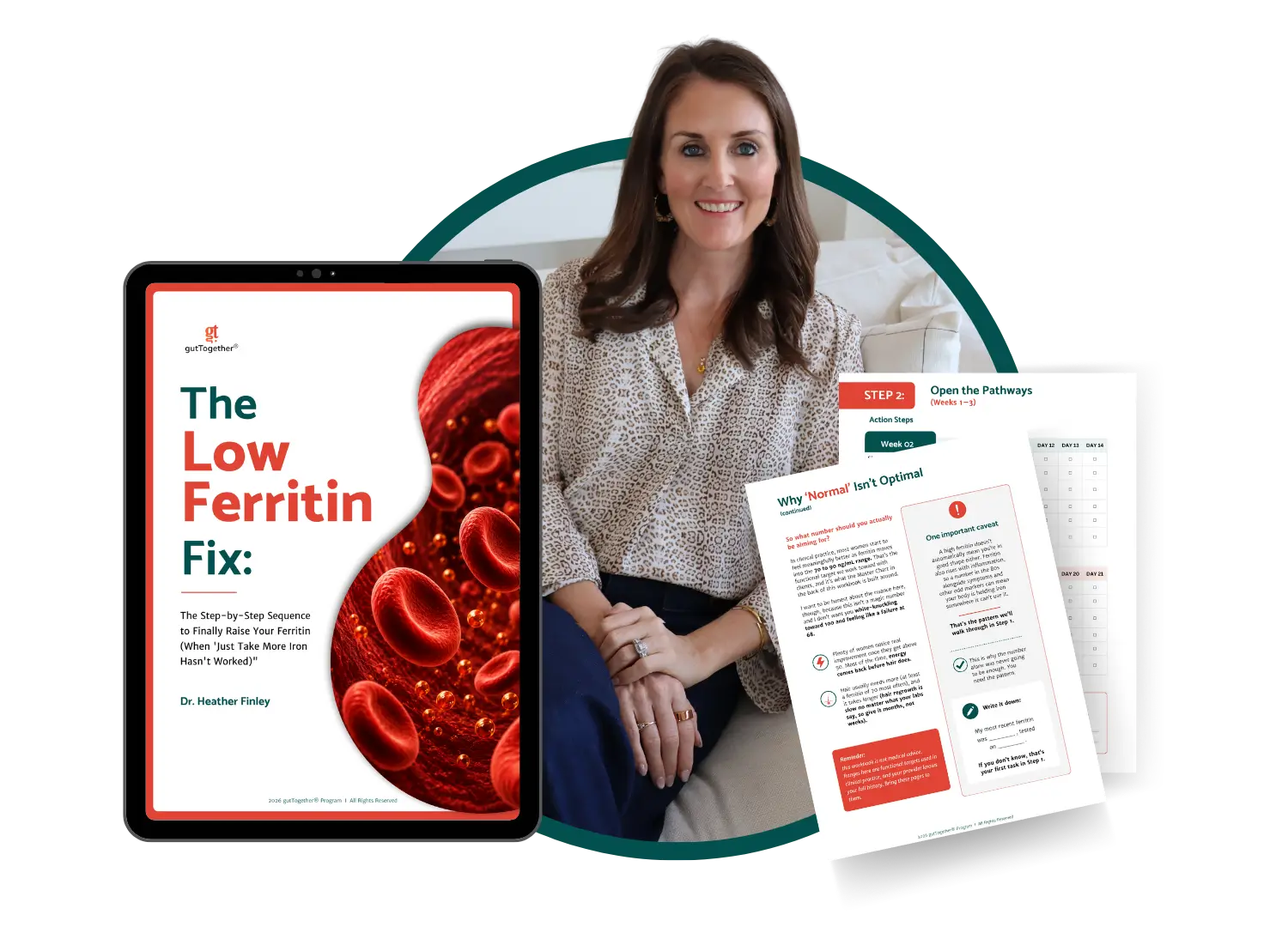
Low Ferritin Trouble Shooting
Only $27
A step-by-step roadmap for women whose labs came back "normal," whose iron supplements did nothing (or wrecked their stomach), and who are done guessing
Written by a functional dietitian whose own ferritin went from 9 to 77 in four months
The Lab Interpreter
(available as an add on)
Imagine entering your labs and understanding hat they mean in less than 1 minute.
You put your numbers in, ferritin, iron, TIBC, saturation, the whole panel, and it reads them together the way they’re meant to be read: which of the nine patterns you’re in, whether iron is your next move or whether something has to happen before it, and which markers to keep an eye on at your retest.
I sent it to a few colleagues before it went out and they got a little unhinged about it:


FREQUENTLY ASKED QUESTIONS
Let’s make sure you have all the details.
How do I get it?
Instantly. It lands in your inbox right after checkout, and you’ll have permanent access.
What format?
A digital workbook you can read on any device or print. The worksheets are designed to be filled in.
How long does it take to work through?
You can read it in about 20 minutes. Working through it properly takes a few weeks, because step one involves getting labs run.
I'm currently on iron my doctor prescribed. Should I stop?
Please don’t stop anything you’ve been prescribed based on a workbook. Work through it and bring your questions to whoever prescribed it.
Is this relevant if I've had an infusion?
Yes, and arguably more so. Infusions fill the warehouse. They don’t address why it emptied. Plenty of women are back where they started within a year or two, and the steps in here are about the underlying picture.
Is this for pregnancy or postpartum?
The framework applies, and mineral demands during those seasons are significant. But pregnancy and postpartum warrant individual guidance, so use this as a way to have a more informed conversation with your provider rather than a stand-alone plan.
Do you work with men?
The physiology in here applies broadly, but the workbook is written for women, and low ferritin in men warrants a different investigation.
Refunds?
Because it’s an instant digital download, all sales are final. If something isn’t working on your end, email us and we’ll fix it.
One last thing
You're still here, hello!
After every appointment that went nowhere and every supplement that didn’t do what it was supposed to, some part of you still thinks this is figure-out-able. I love that mentality!
To raise your ferritin, you don’t need another iron supplement. You need to work the steps in an order that works for your body. Thats what I will teach you.
So a woman can take iron every single day for six months and watch her ferritin sit at 27, and it isn’t because she is taking the wrong form. It’s because iron was being handed to a runner who wasn’t ready to run
Instant digital access. Yours forever.